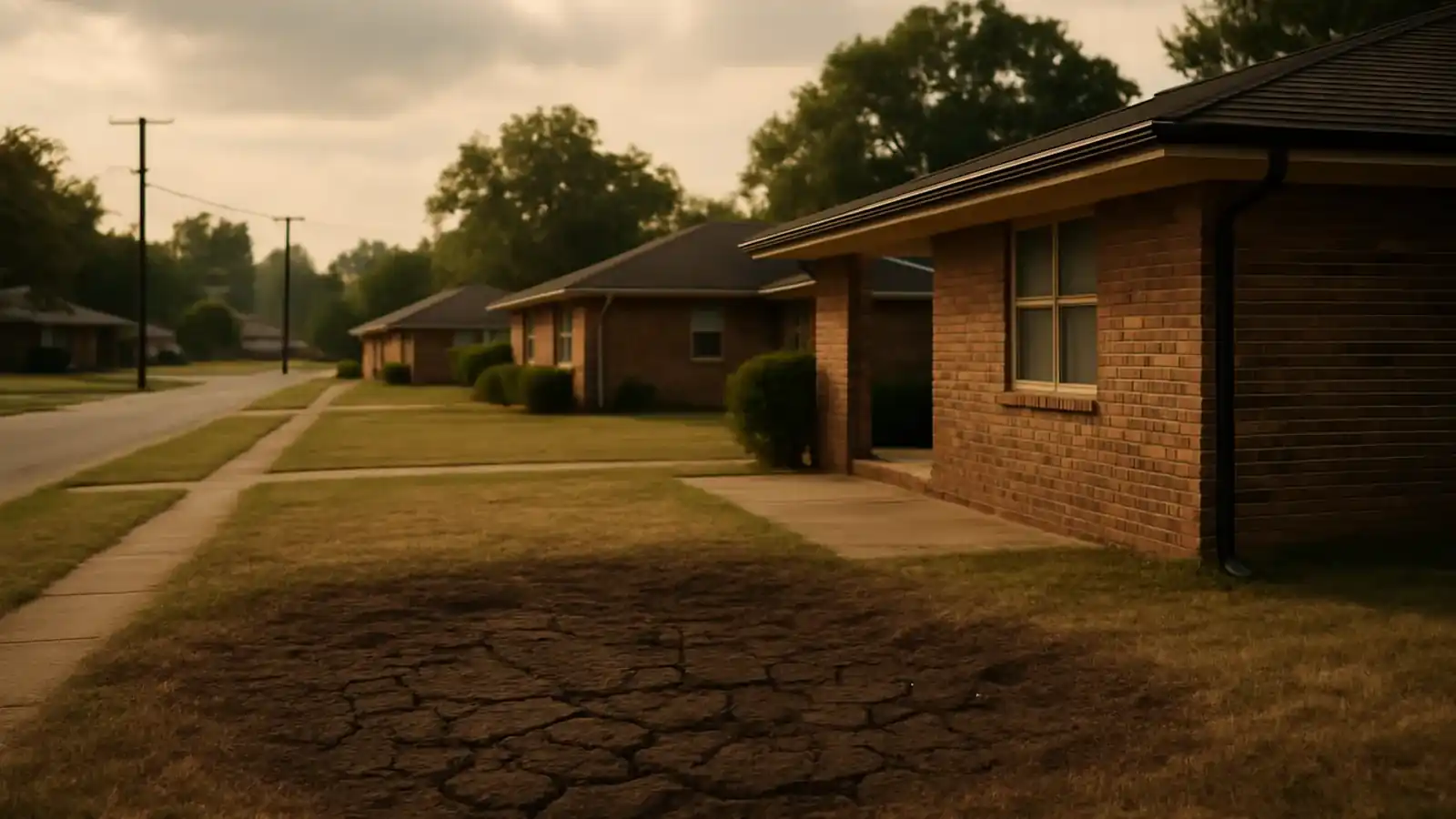
Requests come in from Montgomery and from nine River Region towns around it: Prattville, Millbrook, Wetumpka, Pike Road, Deatsville, Tallassee, Selma, Clanton and Troy. Each one goes to one independent local specialist for a measured evaluation. For the towns farther out, ask whether travel shows up as a separate line on the price.
PrattvilleMillbrookWetumpkaPike RoadDeatsvilleTallasseeSelmaClantonTroy
Every town covered, and what changes there
Every town below has a page of its own, since the soil and the age of the houses shift from one end of the River Region to the other. In brief:
Prattville: Two Prattvilles, two foundation stories
Prattville's growth split its housing into two populations that fail differently. Read what that means for a Prattville property.
Millbrook: Newer houses, still-moving ground
Millbrook's expansion came fast and recent, which means most foundation calls here are on homes under thirty years old, and homeowners are often surprised that a house this young has anything wrong with it. Read what that means for a Millbrook property.
Wetumpka: Building on the edge of a crater
Wetumpka sits on one of the more geologically distinctive spots in the Southeast: the eroded rim of an ancient impact structure, where the normal layered bedrock of central Alabama was disturbed and rearranged. Read what that means for a Wetumpka property.
Pike Road: Big houses, big footprints, more ground to disagree with
Pike Road's growth built substantial homes on generous lots, and footprint size changes the foundation math. Read what that means for a Pike Road property.
Deatsville: One-off houses on individual ground
Deatsville's housing wasn't mass-graded into subdivisions, which changes both the problems and the diagnostics. Read what that means for a Deatsville property.
Tallassee: Mill-era construction and a century of moisture
Tallassee's older housing dates to the textile-mill era, and those homes carry the construction standards of their period: shallow footings by modern measure, brick pier foundations, and framing that has stood through a hundred Alabama summers. Read what that means for a Tallassee property.
Selma: The Black Belt at full strength
If Montgomery sits at the edge of the Black Belt, Selma sits in the heart of it. Read what that means for a Selma property.
Clanton: A soil transition runs through this county
Clanton sits near a genuine geological boundary: the Black Belt's expansive clays to the south giving way to the sandier, more variable soils of the Alabama upland to the north. Read what that means for a Clanton property.
Troy: South of the Black Belt's core
Troy sits far enough south that its soils differ meaningfully from Montgomery's: less of the extreme vertisol behavior that defines the Black Belt proper, more variable ground with sandier components in places. Read what that means for a Troy property.
The soil changes as you cross the region
This service area spans a real geological gradient, and it shows up in the work. Selma and the southwest sit in the Black Belt's heart, where vertisol clays are deepest and their seasonal volume change is greatest: the highest-amplitude soil in the region. Montgomery, Prattville, and Pike Road sit along its edge, with the classic swell-shrink cycle moderated somewhat but still dominant. Clanton straddles the transition to sandier upland soils, where drainage-only solutions succeed far more often. Troy, south of the core, generally moves less than the metro average. Wetumpka is its own case entirely, sitting on the disturbed geology of an ancient impact structure where conditions vary lot to lot.
Because the ground changes this much over a short drive, a single pier depth quoted for the whole region should make you suspicious. Each town page describes its own soil, and the evaluation measures the lot you actually own.
Two housing eras, everywhere in the region
Montgomery and the nine towns share one housing pattern. The older houses stand on brick pier-and-beam foundations; most homes from the mid-century onward sit on slab-on-grade. The Black Belt clay pushes on both the same way, but the fixes have little in common. A pier-and-beam house needs pier, sill and girder repair, done with care on historic houses. A slab house needs perimeter piers, interior support or lifting, placed wherever the floor survey finds the low spots. The evaluation establishes which kind of house you have before any price is written.
Between two of these towns, or a little past the edge of the list? Ask, and ask whether the distance adds a travel charge.
What it means when a town is covered
A listed town means your request is handled the same way a Montgomery request is: it goes to one independent local specialist, and a good evaluation at your address should include the same laser floor survey, crack measurements and written scope. If the specialist charges for travel, that charge belongs on its own line, not hidden inside the repair prices, and on a far-out job it is worth seeing that figure before you agree to anything.
Most foundation repair is booked ahead rather than rushed, so ask whether a farther address affects when the visit can happen.
The nine towns above are the ones this site has written up, each on a page about its own ground. That is the real limit of the list: not a circle on a map, but the places where the soil and the houses have been described in enough detail to help a homeowner there.
Coverage questions
Is there an extra charge to come out to the outlying towns?
If travel is charged, ask to see it as a separate line, and ask before you agree to anything. A travel cost tucked into the repair prices makes the scope impossible to compare with a second bid.
My address is not on the list. Is it still covered?
Often, yes, so ask anyway. The list covers the towns this site has written about; it is not a fence. Send your address, and the local specialist can tell you whether they work there.
Is the first visit free?
It depends on the company. Many local specialists don't charge for the first visit; ask when they call, before they come out. Whatever the answer, ask to keep the floor elevations, the crack readings and the written findings, whether you go ahead or not and whether or not that specialist prices the work.
Why does the price differ between towns for the same job?
Because the soil changes between towns. Each town page above describes the local ground, and a price should follow what the visit measures at your own address, not an average for the River Region.
Get a Montgomery foundation evaluation
Tell us what the house is doing (stair-step cracks, doors that stick every August, sloping floors, separating trim) and we'll pass it to one independent local specialist for an evaluation. A local specialist who works in Montgomery will call you back.